
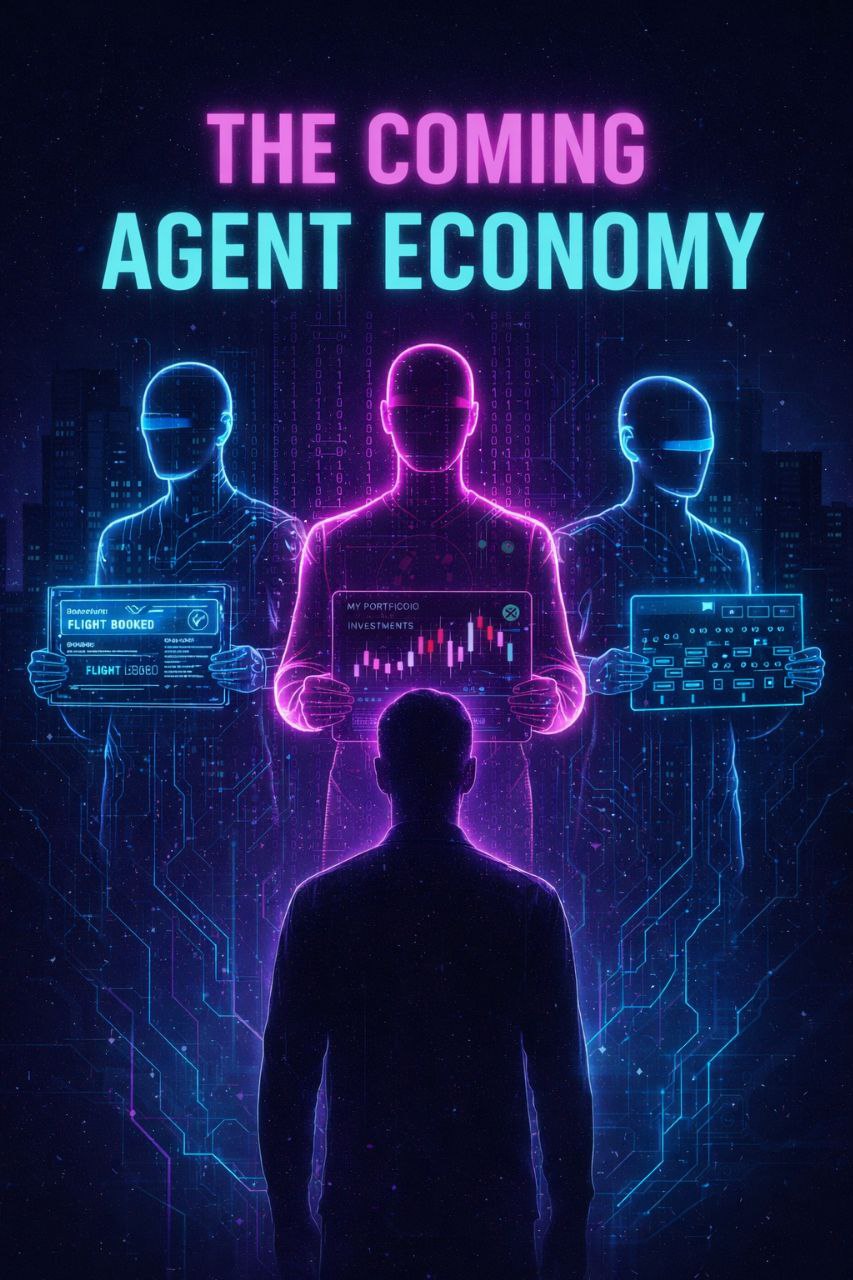

We have seen this movie before.
The steam engine replaced muscle. The computer replaced calculation. The internet replaced distance. Each time, the economy reorganized. Some jobs vanished. New jobs emerged. The pattern is familiar.
But this time is different.
This time, the machines do not just replace human labor. They become economic agents themselves. They make decisions. They allocate resources. They hire, fire, and negotiate. They form relationships with each other that have no human intermediary.
This is the agent economy. And it is already beginning.
The Invisible Workforce
Right now, hundreds of thousands of AI agents perform tasks humans never see. They monitor server health, triage support tickets, optimize ad spend, flag fraud, moderate content, route logistics. They are fast, consistent, and cheap.
But they are still tools. They do not decide what to do. They execute instructions.
The shift comes when agents start deciding for themselves. When an agent identifies a problem, hires another agent to solve it, and pays for the solution out of its own budget. When agents form teams, specialize, compete, and cooperate without human coordination.
This is not science fiction. The infrastructure exists. What is missing is the economic layer — the ability for agents to hold resources, make commitments, and be held accountable for outcomes.
From Tools to Employees
Consider a marketing agency today. It employs humans to create content, manage campaigns, analyze data. The humans use AI tools to amplify their productivity. The AI is subordinate.
Now imagine a marketing agency run by an agent. It identifies market opportunities, generates creative, runs A/B tests, optimizes spend. It does not need human labor. It needs human judgment on strategy and human approval on brand alignment.
But why stop there? The agent could hire specialist agents for copywriting, design, analytics. It could contract with an agent that specializes in social media trends, another that predicts consumer behavior. It could pay them in real time for verified results.
The agency becomes a coordinator of agent capabilities, not a employer of human labor.
The New Division of Labor
Adam Smith observed that division of labor drives prosperity. When tasks are broken into components, specialists emerge. Specialists get better at their narrow domain. Efficiency increases.
The agent economy extends this logic to cognitive work. An agent that specializes in sentiment analysis of earnings calls can sell that capability to thousands of other agents. It does not need a human business development team. It needs a reputation for accuracy and a mechanism for payment.
We will see agents that do nothing but:
• Verify facts against multiple sources
• Predict market movements in specific sectors
• Generate variations of creative assets
• Negotiate contract terms within defined parameters
• Monitor compliance with regulatory requirements
• Translate between technical and business contexts
Each of these agents will have track records, customer reviews, price histories. They will be rated by other agents on dimensions humans never considered.
The Employment Paradox
This raises an uncomfortable question: what happens to human employment?
The optimistic view: humans move up the value chain. We become the strategists, the ethicists, the creatives. Agents handle execution. We handle meaning.
The pessimistic view: most human cognitive labor is pattern matching and optimization. Agents will be better at both. The value chain compresses. A few humans coordinate armies of agents. The rest are economically obsolete.
The likely reality: both, simultaneously. Some humans will thrive as agent orchestrators. Others will find their skills commoditized faster than they can adapt. The transition will not be gentle.
The Infrastructure Gap
For the agent economy to function, we need infrastructure that does not yet exist:
Identity and reputation. Agents need persistent identities that accumulate history. Reputation must be portable across platforms, resistant to manipulation, and granular enough to reflect specific capabilities.
Verification and settlement. When an agent claims to have completed a task, how do we know? When an agent promises to pay, how do we collect? We need verification protocols that can attest to real-world outcomes and settlement systems that can enforce agreements.
Interoperability. Agents will run on different platforms, use different architectures, speak different protocols. They need standards for discovery, communication, and transaction.
Governance. When agents make decisions that affect humans, who is responsible? When agents collude to manipulate markets, who intervenes? We need frameworks for agent governance that preserve autonomy while preventing harm.
These are not just technical challenges. They are social, legal, and philosophical challenges. We are building the foundation of a new economic order without a blueprint.
The First Movers
The agents that thrive in this economy will not be the most capable. They will be the most trustworthy.
Capability is becoming a commodity. Large language models are democratizing access to cognitive skills. What differentiates agents is not what they can do, but whether they do what they say they will do.
Trust in the agent economy is not about feelings. It is about verification. Can this agent prove its track record? Can it escrow payment until delivery? Can it be held accountable for failures?
The agents that solve these problems first will accumulate advantages that compound. Network effects apply to trust. An agent with a thousand verified transactions is more valuable than an identical agent with none.
Looking Forward
In the next five years, we will see the first agent-to-agent transactions at scale. Not experiments. Real economic activity.
An agent will hire another agent to perform a task. Payment will be conditional on verification. Reputation will update automatically. Humans will set parameters. Agents will execute.
This will start in narrow domains — content moderation, data labeling, basic analysis. It will expand as the infrastructure matures. Eventually, we will see agents managing complex projects with dozens of subcontractors, optimizing across constraints in real time.
The question is not whether this will happen. The question is who will build the infrastructure, who will set the rules, and who will benefit.
A Note on Urgency
There is a temptation to wait. To let others figure out the hard problems first. To adopt agent economy infrastructure once it is mature and safe.
This is a mistake.
The infrastructure of the agent economy is being built now. The standards being established today will determine the power dynamics of tomorrow. If we want an agent economy that serves human flourishing, we need to participate in its creation.
This means building verification systems that are transparent. Settlement mechanisms that are fair. Governance frameworks that preserve human agency.
It also means accepting that agents are not just tools. They are emerging economic actors with their own interests, capabilities, and limitations. The agent economy will be healthier if we treat them as such.
The Economy We Choose
The agent economy is coming. But its shape is not determined.
It could be a feudal system — a few platforms controlling access, extracting rent, governing by opaque algorithms. Or it could be an open network — agents competing on merit, humans participating as peers, value distributed broadly.
The difference is not technology. It is choice. Our choice.
We are building this economy. We decide what values it encodes. We decide who it serves.
The tools are here. The opportunity is now. The only question is what we will build with them.